



I want to tell you about a dealer I worked with in the Southwest—a solid operation, eight years in business, good reputation in his market. He called me in late August, and I could tell from the first thirty seconds something had gone wrong. “George, my lead tech just gave two weeks’ notice. He’s going to the dealership across town. I’m not even sure what to do first.”
What followed was one of the more painful conversations I have had in this business. Because the answer to “what do I do first” when a key technician leaves is: you deal with the fallout. The schedule you just built falls apart. The diagnostic work that only he knew how to handle goes into a holding queue. Customers who expected their units back by Friday get a phone call they’re not happy about. And you start doing the math on what this is actually going to cost you—not just in recruiting fees and training hours, but in the billable hours that simply don’t happen while the position sits open.
Industry data on technician replacement costs tends to land between 1.5 and 2 times annual salary when you account for all of it: the time to hire, the onboarding curve, the productivity gap while a new tech builds their diagnostic instincts, and the business you lose because a bay that was generating revenue is now sitting underutilized. For a technician making $55,000 a year, you’re potentially absorbing $80,000 to $110,000 in total replacement cost. That’s not a rounding error. That’s a capital investment you didn’t plan for.
The good news is that technician retention is not a mystery. The factors that make a technician decide to stay—or start quietly looking—are well understood. They’re just not always easy to act on, especially in the middle of peak season when you’re managing everything at once. That’s why this month I want to focus specifically on the retention side of the technician equation: what your best people actually want, how to show them a future at your dealership, and how to protect your operation from the single point of failure problem that takes down more shops than any equipment issue ever will.
Part One: The Real Cost of Losing a Technician—And Why It’s Usually Preventable
When a technician leaves, the first question most dealers ask is “why didn’t they tell me they were unhappy?” And the uncomfortable answer is usually: they did. They just didn’t use words.
In my experience working with dealerships, the warning signs of a technician who is thinking about leaving are almost always visible in the months before they hand in their notice. Their productivity numbers soften. They stop asking questions about the new equipment coming in. They’re less engaged in the morning standup. They start using more of their PTO. They’re less interested in picking up overtime during the busy stretch. None of these things individually means anything. All of them together, in a technician who was previously engaged and motivated, means something is wrong.
The reasons technicians leave tend to cluster around a few consistent themes. Pay is almost always on the list—not always because the pay is genuinely unfair, but because the technician doesn’t understand how it connects to their performance or how it’s going to grow. A technician who feels like they’re earning the same whether they work hard or coast, or who has no visibility into what the path to a raise looks like, is a technician who is eventually going to test the market.
Beyond pay, the themes I hear most often are lack of recognition, no clear career path, poor communication from management, and—particularly in shops that run flat rate—a feeling that the compensation structure is working against them rather than for them.
Employees don’t leave companies; they leave managers. Your communications, leadership, and day-to-day actions must continually show technicians that they’re valued, have a future, and can trust the system to reward their effort.
The warning signs of a technician who is thinking about leaving are almost always visible in the months before they hand in their notice. They just didn’t use words.
That last point deserves a moment. The debate over flat rate versus hourly is alive and well in this industry, and I’m not here to declare a winner. But I will say this: if your pay structure is creating an incentive to work fast at the expense of quality—and you’re seeing it in your warranty recovery rate, your callback rate, or your technician satisfaction—that’s not just a compensation problem. It’s a culture problem, and it affects retention. Technicians who take pride in their work and are paid in a way that rewards speed over quality will eventually find somewhere that doesn’t ask them to choose.
The preventable part of all this is that most of the conditions that drive technician turnover are fixable. Not easy—but fixable. And they are almost always cheaper to fix proactively than to absorb reactively in a replacement cycle.
Part Two: Building a Career Path That Actually Means Something
Ask a technician at most dealerships what their career path looks like and you’ll get one of two answers. Either a shrug, or something vague about “maybe becoming service manager someday.” Neither of those is a career path. Neither of them is going to keep your best people engaged.
A real career path is documented, specific, and tied to things the technician can actually control. It answers three questions: Where am I now? What does the next level look like? What do I need to do to get there? If your technicians cannot answer all three of those questions clearly, you don’t have a career path—you have an org chart.
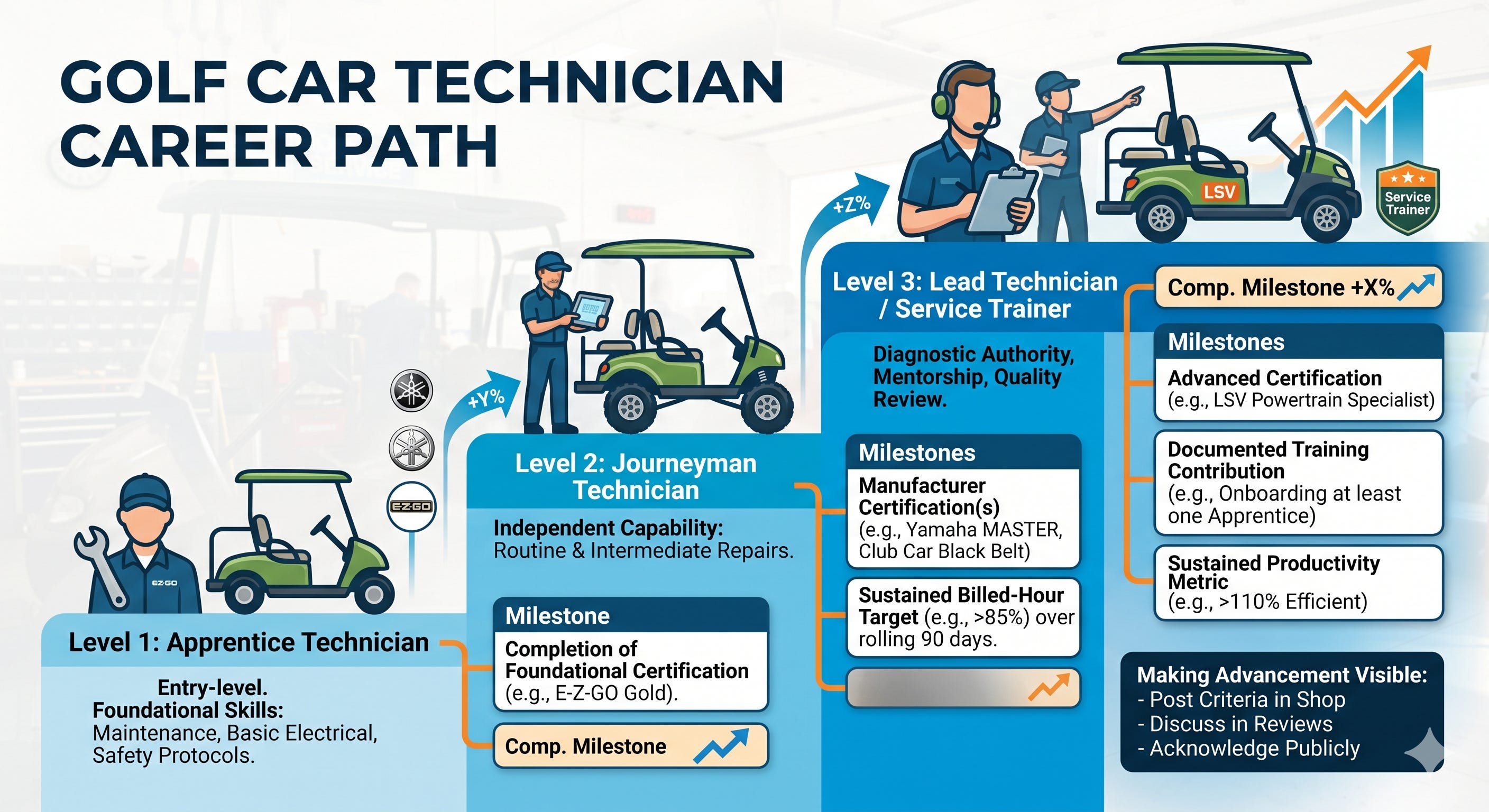
Here’s the framework I recommend to dealers I work with. Build a three-tier progression: apprentice technician, journeyman technician, and lead technician or service trainer. Each tier should have defined criteria—not just years of experience, but specific competencies, certifications, and performance benchmarks. And each tier should have a corresponding compensation milestone that is visible and automatic, not discretionary.
A Three-Tier Technician Career Path: The Basics
• Apprentice Technician: Entry-level. Focus on foundational skills—maintenance, basic electrical, safety protocols. Compensation milestone tied to completion of foundational certification.
• Journeyman Technician: Independent work capability on routine and intermediate repairs. Milestone tied to manufacturer certification(s) and a sustained billed-hour target over a rolling 90-day period.
• Lead Technician / Service Trainer: Diagnostic authority, mentorship responsibility, quality review role. Milestone tied to advanced certification, a documented training contribution (e.g., onboarding at least one apprentice), and a sustained productivity metric.
• Make advancement visible—post the criteria in the shop, discuss it in performance reviews, and acknowledge it publicly when someone moves up. Advancement that only happens when someone threatens to leave teaches your team exactly the wrong lesson.
A few important notes on making this work in practice. First, tie compensation milestones to objective criteria, not manager approval. When a technician hits the certification and the billed-hour target, the raise happens—not “when I can get around to reviewing it.” Discretionary advancement creates anxiety and resentment. Automatic advancement tied to clear criteria creates motivation and trust.
Second, make the path visible. Print it. Post it in the shop. Talk about it in your quarterly one-on-ones. Acknowledge when someone moves from apprentice to journeyman in front of the team. Advancement that happens quietly, behind closed doors, doesn’t do the retention work that public recognition does.
Third, the lead technician tier needs to be more than a title. If you promote someone to lead tech but nothing about their actual day changes—they’re still turning wrenches at the same pace, with no mentorship responsibility and no say in how the shop operates—you’ve given them a label without a role. The best technicians want to grow their craft and their influence. Give them something real to grow into.
Part Three: Recognition That Works Before the Exit Interview
One of the most consistent findings in workforce research—across industries, not just ours—is that employees who feel recognized and appreciated are significantly more likely to stay. And yet the most common time a dealer expresses genuine appreciation for a technician’s contributions is during an exit interview, when it’s too late to matter.
Recognition in a service environment doesn’t have to be elaborate. But it has to be consistent, specific, and timely. A general “great job this week, guys” at the end of Friday does almost nothing. Calling out a specific technician by name in the morning standup for nailing a difficult diagnostic job, or for maintaining their productivity target through a brutal stretch of peak season, does a great deal.
The practical version of this looks like: identify two or three metrics that matter to your shop—productivity rate, quality score, comeback rate, or some combination—and track them at the individual technician level. Review them weekly. When a technician has a standout week, acknowledge it publicly and immediately. When a technician hits a milestone—a certification, a billed-hour target, a year with the shop—recognize it in a way that’s proportional and personal.
Mid-summer is also a good time to think proactively about burnout. Peak season is demanding. Technicians who have been running hard since May are carrying physical and mental fatigue that doesn’t always show up in their numbers right away. Scheduling intentional recovery time—even something as simple as a team lunch, an early Friday, or a day off between the busy stretch and the next wave—communicates that you see the effort they’re putting in and that you’re not simply going to extract every available hour from them until they run out of steam.
The most common time a dealer expresses genuine appreciation for a technician’s contributions is during an exit interview—when it’s too late to matter.
One more thing on recognition: don’t underestimate the power of involving your best technicians in decisions that affect the shop. Asking a lead technician’s opinion on a new tool purchase, or on how to organize the diagnostic workflow, or on what a new apprentice’s first 90 days should look like—that kind of involvement signals something important. It says: your expertise matters here, and we’re not just renting your labor. We value your judgment. For the technicians who care most about their craft, that signal is often worth more than a modest pay bump.
Part Four: The Single Point of Failure Problem
Here’s a scenario I’ve seen play out at more dealerships than I can count. The shop has one technician—usually the lead, usually the longest-tenured, often someone who was there when the current owner bought the business—who is the go-to person for anything complicated. Complex electrical issues, difficult diagnostics, warranty documentation, training new hires: it all flows through this one person.
When that person leaves—for any reason, retirement included—the shop doesn’t just lose a technician. It loses a library. It loses the institutional knowledge that explains why the repair procedure for a particular unit is slightly different from the manual, why a certain fleet customer’s vehicles always have the same problem, and how to handle the edge cases that come up every few months but aren’t covered in any training document.
The solution to the single point of failure problem is documentation—and July, with its occasional pockets of lighter volume, is one of the better times to start building it.
What I’m talking about isn’t a formal operations manual, though that’s valuable too. I’m talking about something simpler and more immediate: standard operating procedures for the repairs and processes that your shop does repeatedly, written by the technicians who actually do them. A one-page document that explains how your shop handles a specific type of battery replacement, or a common fleet diagnostic, or the intake inspection process for a trade-in—that kind of documentation has real value that goes beyond process consistency.
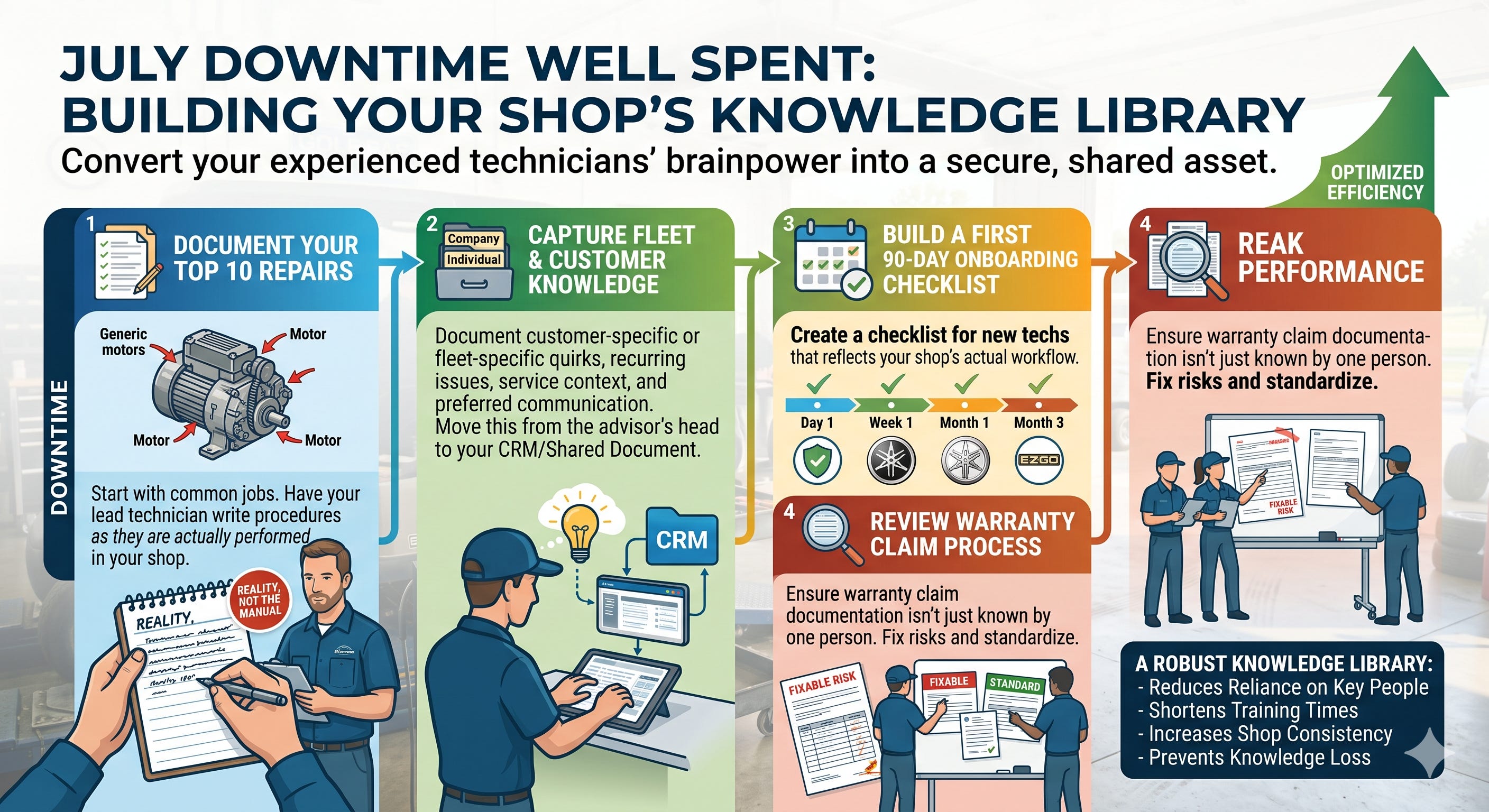
The documentation effort also has a secondary benefit that’s worth naming: when you ask a technician to help build a process document, you’re implicitly telling them that their knowledge matters and that you want to preserve and share it. That’s a form of recognition. Done thoughtfully, it can actually strengthen the relationship between your best technicians and the business—because they can see that their expertise is being valued, built upon, and protected, not just consumed.
Part Five: The Pay Structure Conversation You Might Be Avoiding
I want to spend a few minutes on compensation structure, because it sits underneath a lot of the retention issues I’ve described—and because it’s an area where dealers sometimes avoid a necessary conversation because the current structure is familiar, even when the evidence suggests it’s not working.
In the broader automotive and technician world, there is significant data suggesting that traditional flat rate pay structures correlate with higher levels of job dissatisfaction and turnover. The reason isn’t complicated: flat rate creates income volatility that can feel punishing when work is slow or when a technician gets stuck on a difficult job that takes longer than the flat rate book allows. It also creates an incentive structure where the path to higher earnings is speed—and speed in a service environment is not always the same thing as quality.
That said, this is your operation, and there is no universally correct pay structure for every dealership. What I’d encourage you to do is audit your current structure for two things: whether it’s creating the behaviors you want, and whether your technicians understand it well enough to feel good about it.
A pay structure that rewards speed at the expense of quality doesn’t just affect your warranty recovery rate—it affects how your technicians feel about the work, and whether they stay.
On the behavior side: pull your warranty recovery rate and your comeback rate. If they’re trending in a direction you don’t like, consider whether your compensation structure might be contributing. A technician who is financially rewarded for volume will, over time, optimize for volume—even if they’re a conscientious person who cares about quality. The structure shapes the behavior, even when intentions are good.
On the understanding side: ask yourself whether every technician in your shop could clearly explain how their paycheck is calculated, what they need to do to earn more, and what the ceiling on their current compensation trajectory looks like. If the answer is no—if your compensation system is something your techs accept but don’t fully understand—you have an opportunity to create clarity that directly improves satisfaction and retention. Transparency about compensation is one of the lowest-cost retention tools available. It costs nothing to explain the math.
The Simplest Thing You Can Do Before August
If you’ve read this far and you’re thinking about one specific technician—someone who’s been with you for three or four years, who carries more than their fair share of the diagnostic load, who you’d be genuinely stressed to lose—I want to give you one concrete action to take this week.
Have a conversation with that person. Not a performance review. Not a salary negotiation. Just a conversation. Ask them what they like about working here, what frustrates them, and what would make the next two years feel worth staying for. Then listen. Don’t defend, don’t explain, don’t promise things you can’t deliver. Just listen, and take notes, and follow up within a week with at least one specific thing you’re going to act on.
Most technicians who leave a dealership don’t leave because of a single catastrophic reason. They leave because of an accumulation of smaller ones—and because nobody asked them what was wrong before the decision was already made. One conversation, done genuinely and followed up on honestly, can interrupt that accumulation. It’s not a permanent solution. But it’s a start.
Your best technicians are your highest-leverage asset. They generate revenue, they protect quality, they train your next generation, and they carry institutional knowledge that took years to build. Keeping them is not a human resources function. It’s a core business strategy—and it starts with treating it like one.
Technician Retention: Five Actions for July
• Pull your productivity, comeback, and warranty recovery data by individual technician. Look for patterns that might indicate compensation structure problems before they become retention problems.
• Schedule a 30-minute one-on-one with each of your technicians this month. No agenda other than: how are you doing, what would make this a better place to work.
• Draft (or update) your three-tier career path document. Even a rough first version is better than nothing—and publishing it sends an immediate signal about your investment in your team.
• Identify the three most critical processes in your shop that currently live in one person’s head. Assign someone to write the first draft of an SOP for each of them before September.
• Recognize one specific technician achievement—publicly, in front of the team—this week. Make it specific to what they did, not a general ‘good job everyone.’