


Let me tell you about a conversation I had last month with the owner of a golf car dealership in Florida. Nice guy, runs a solid operation, moves a decent number of units every year. We were talking about his sales team, and he said something that stopped me cold:
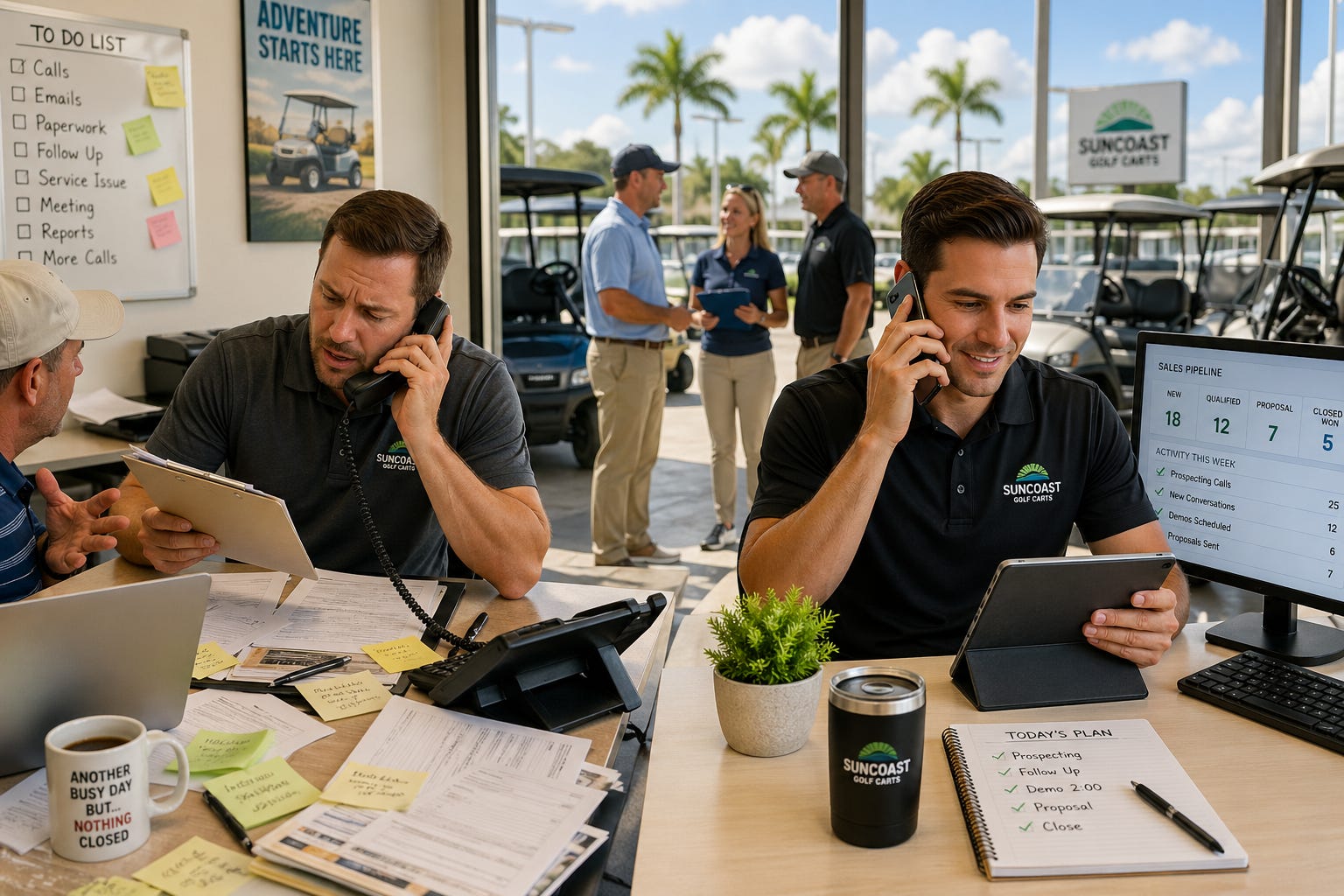
“George, I don’t understand it. My guys are busy all day, every day. They’re constantly running around, taking calls, and meeting with customers. But when I look at the numbers at the end of the month, I can’t figure out where all that activity went. We’re not closing the deals we should be closing, and we’re definitely not capturing the commercial accounts that are out there.”
Sound familiar?
Here’s the uncomfortable truth that most golf car dealership owners don’t want to hear: your sales team is probably wasting about 60% of their time on activities that will never, ever result in a sale. Not because they’re lazy. Not because they don’t care. But because nobody—and I mean nobody—ever taught them the difference between being busy and being productive.
And if you’re the owner who’s also playing sales manager (which, let’s be honest, describes about 80% of you reading this), you probably didn’t get a manual on this either. You learned to sell golf cars because you’re good with people, you know the product, and you figured it out as you went. That’s great for getting your dealership off the ground. But it’s a terrible foundation for building a sales team that can consistently capture high-value commercial accounts while still serving the walk-in retail customers who keep the lights on.
So let’s talk about what’s really happening with your sales team’s time, attention, and results. And more importantly, let’s talk about what you can actually do about it.
The 60% Problem: Where Sales Time Goes to Die
A few years back, I ran a workshop with about twenty machinery and equipment sales reps from various dealerships. These weren’t rookies—most had been in sales for five to ten years. I asked them to track their time for a full month and categorize it into four buckets:
Sales Investment Time: Organizing yourself, planning your territory strategy, learning about new products, staying current on financing options—basically, sharpening your tools.
Prospecting Time: Actually hunting for new opportunities, identifying potential customers, and making first contact with accounts that don’t know you yet.
Direct Selling Time: Working active deals from the first real conversation through close—needs analysis, proposals, demonstrations, negotiations, all of it.
Other Time: Everything else. Paperwork that doesn’t move deals forward. Meetings that could’ve been emails. Helping the service department find a part. Scrolling through your phone while sitting in your truck in a parking lot because the customer cancelled at the last minute, and you’re not sure what to do next.
Guess what the average breakdown looked like?
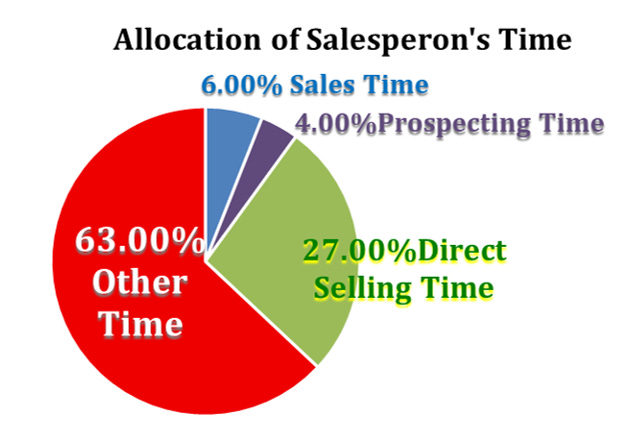
Sixty-three percent. Nearly two-thirds of their working hours spent on activities that had absolutely nothing to do with finding customers, selling to customers, or keeping customers.
Now, before you think “Well, my team’s not like that,” let me tell you—yes, they probably are. Unless you’ve put specific systems in place to prevent it, this is the default state of most sales operations. It’s not that people are trying to waste time. It’s that without clear direction, defined processes, and consistent accountability, salespeople naturally gravitate toward activities that feel productive but don’t actually produce results.
They’ll spend an hour perfecting a proposal for a customer who’s never going to buy. They’ll drive across town for a fifteen-minute conversation that could’ve happened on the phone. They’ll get pulled into service issues, parts questions, and administrative tasks because they feel urgent, even though they don't move the revenue needle.
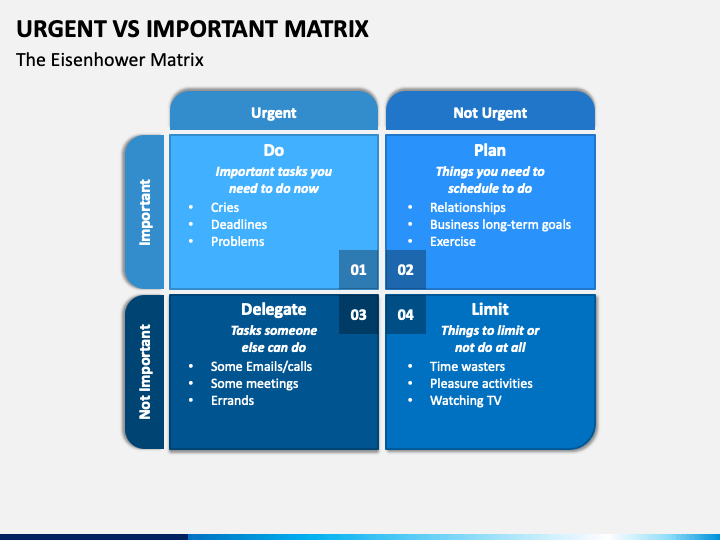
And here’s the thing that makes this especially dangerous in the golf car business: you can get away with it for a while. If you’ve got a decent location and the phone rings enough, you’ll move some units just from walk-in traffic and existing customers who need to replace aging equipment. But you’ll never capture the commercial accounts that represent the real money—the resorts, the industrial facilities, the municipalities—because those deals require focused, strategic selling over time.
Those commercial customers aren’t walking through your door. They’re not calling you out of the blue. They’re making purchasing decisions based on relationships that were built months or even years before they write a purchase order. And if your sales team is spending 63% of their time on random activities, they’re simply not building those relationships.
The Two Numbers That Actually Matter
Alright, so if most of your sales team’s time is disappearing into the void, what should you actually be measuring? I’m going to give you two metrics that, if you get them right, will transform your dealership’s sales performance.
Deal Visibility Rate: The percentage of deals happening in your territory that your team actually knows about early enough to influence the outcome.
Deal Closure Rate: The percentage of deals you participate in that you actually win.
Let’s start with visibility. In a perfect world—or at least in a well-managed sales territory—your team should be aware of 80–85% of the potential deals in your market before the customer has made up their mind about who to buy from. Not 80% of deals after the customer has already decided. Not deals where you get called in at the last minute to provide a “comparison quote” for a customer who’s already chosen your competitor. I’m talking about early awareness, when you still have time to shape the customer’s thinking, build trust, and position your dealership as the obvious choice.
Most golf car dealerships are probably seeing about 40–50% of available deals, and they’re seeing them late. That means half the opportunities in their market are being decided without them in the room. And when you do get invited to quote, you’re often just being used to validate pricing for a deal that’s already been awarded to someone else.
Now let’s talk closure rate. If you’re aware of a deal early and you’re actually participating in the process, you should be closing somewhere between 50–60% of those opportunities. Not every deal—that’s unrealistic. Some customers will have existing relationships you can’t overcome. Some will have specific requirements that your product mix doesn’t meet. And yes, some will just buy on price from whoever’s cheapest that day.
But if you’re closing less than 50% of the deals you’re actively working, something’s wrong. Either your team doesn’t know how to sell, your products aren’t competitive, your pricing is out of line, or you’re pursuing the wrong opportunities in the first place.
Here’s the math that should get your attention: if you see 80% of deals and close 55% of what you see, you’re capturing 44% market share in your territory. If you’re only seeing 40% of deals and closing 45% of those, you’re at 18% market share. Same market, same products, same pricing—the only difference is sales execution.
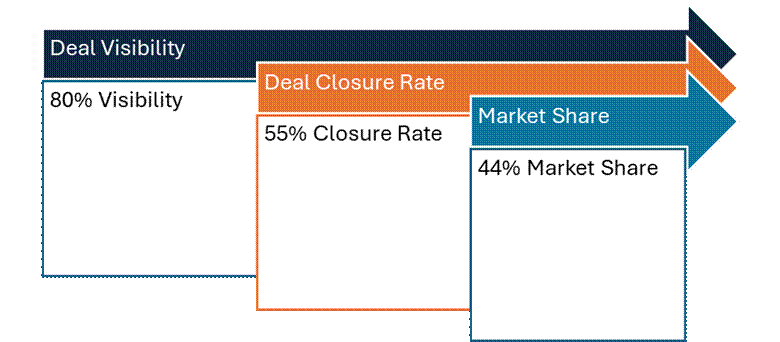
So the question isn’t whether your team is “working hard.” The question is whether they’re systematically increasing deal visibility and consistently converting opportunities into closed sales. Everything else is just noise.
Why Most Golf Car Salespeople Fly Blind
Here’s where it gets interesting—or frustrating, depending on your perspective. In the golf car business, most sales happen one of two ways:
Path One: Customer walks in or calls because they need a golf car. Maybe their old one died. Maybe they’re opening a new facility. Maybe they just decided it’s time. They already know they want to buy—the only question is whether they buy from you. This is reactive selling, and it’s what most dealerships are built around.
Path Two: Customer doesn’t know they need to buy yet, or they’re in the early planning stages for a project that won’t happen for six to eighteen months. A golf course is planning a fleet refresh. A resort is expanding. An industrial park is evaluating transportation options. These are the deals that require visibility and relationship-building, and they’re the deals most salespeople never see coming.
If your entire sales approach is built around Path One—waiting for customers to come to you—you’re missing at least half the market. And you’re missing the best half: the commercial accounts with real budgets, repeat purchase cycles, and long-term service revenue potential.
So why don’t more salespeople pursue Path Two opportunities? Because nobody taught them how. It requires a completely different skill set: you have to know who the potential customers are before they contact you; you have to build relationships with people who don’t have an immediate need; and you have to play the long game. The golf course that’s going to buy fifteen to two hundred units next spring isn’t going to buy anything from you today. But if you’re not in regular contact with them over the next nine months, someone else will be.
Most salespeople—especially in smaller dealerships where the owner is also the sales manager—frequently don’t have a system for doing this. They’re great at closing retail customers who walk through the door. They’re terrible at creating opportunities with commercial accounts who need to be cultivated over time.
The cost of low deal visibility is way more expensive than the time investment required to fix it.
Building a Territory That Actually Works
Alright, enough on the problem. Let’s talk about solutions. If you want your sales team to see more deals earlier, you need to give them a structured approach to account management. Not a vague instruction to “get out there and call on customers,” but a specific system they can follow every single week.
Step One: Know What You’re Hunting
Start by identifying every potential commercial account in your territory. And I mean everyone. Golf courses, resorts, hotels, industrial facilities, universities, municipalities, parks departments, airports, hospitals, retirement communities—anywhere that uses or could use golf cars or utility vehicles.
This isn’t a one-afternoon project. But here’s a simple approach: have your salesperson add five accounts per day to a prospect database. Just five. Within a month, they’ll have over a hundred accounts identified. Within a quarter, they’ll have comprehensive territory coverage.
For each account, capture basic information: company name, location, key contact, phone number, email, approximate fleet size, and equipment types they’re using. You’re not trying to write a dissertation—you’re building a target list.
Now here’s the critical next step: classify those accounts by priority. Not every account deserves the same level of attention. The golf course with forty units that they replace every four to five years? That’s an A account, and it deserves personal visits, regular contact, and strategic relationship-building. The small contractor with two utility vehicles who might buy one more in the next three years? That’s a D account, and it can be handled with periodic emails and phone calls.
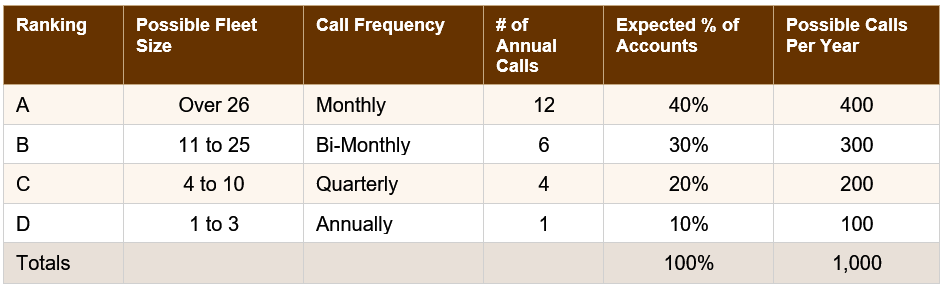
Most dealerships try to treat every account the same, which means they’re either over-investing in small accounts or under-investing in large ones. Neither approach works. You need to match your effort to the opportunity. A accounts get face-to-face visits every three to four weeks. B accounts get visits every two to three months, plus regular phone contact. C and D accounts get periodic phone calls, email campaigns, and invitations to demo days or promotional events.
Step Two: Plan Your Week Like You Actually Mean It
Here’s a radical idea: what if your salespeople actually scheduled their prospecting time and protected it like they’d protect a meeting with their biggest customer?
Most salespeople approach their week like this: “I’ll make some calls when I have time.” Translation: “I won’t make any calls, because something that feels more urgent will always come up.”
Instead, try this: block out Tuesday and Thursday mornings from 8:00 to 11:00 for prospecting calls. That’s it. Those six hours per week are sacred. No service meetings. No administrative catch-up. No “quick favor” for the parts department. Just focused, systematic contact with high-priority accounts.
In six hours, a salesperson can realistically make thirty to forty meaningful calls or drop-by visits. That’s 120–160 customer contacts per month. That’s nearly 2,000 contacts per year with the accounts that represent the majority of your revenue potential.
And here’s what happens when you do this consistently: you start hearing about deals before your competitors do. You become the person that buyers think of when they have a problem. You’re not chasing opportunities—you’re creating them, because you’ve built relationships before the customer even knew they had a need.
But this only works if you actually do it. Every week. Not when you feel like it. Not when things are slow. Every single week, because deal visibility isn’t an event—it’s a discipline.
Step Three: Use Technology Like It’s 2026
Look, I know a lot of golf car dealers are… let’s say “traditional” in their approach to technology. I’ve walked into dealerships where the customer database is still on index cards. I’m not judging—well, okay, I’m judging a little—but that approach doesn’t work anymore.
You need a basic CRM system. It doesn’t have to be fancy. It doesn’t have to cost thousands of dollars per month. But it needs to do three things:
Track every customer interaction. When did you last talk to this account? What did you talk about? When should you follow up? If this information lives in your salesperson’s head, it disappears the day they leave for your competitor.
Schedule follow-up activities automatically. Your CRM should remind your salesperson when it’s time to contact an account again. Not “when they remember.” Not “when they get around to it.” The system should generate a task that says “Call Johnson Resort & Spa today” because it’s been six weeks since the last contact.
Capture website and email engagement. Here’s something most dealership owners don’t realize: 90% of your potential customers are checking out your website before they ever call you. If your website can identify who’s visiting and what they’re looking at, you’ve got incredibly valuable intelligence about who’s in the market right now.
Dealerships are using this technology to capture three to five times more leads than dealers who just wait for the phone to ring. When someone from Sunset Golf Club spends ten minutes on your website looking at fleet pricing and utility vehicles, that’s not a coincidence—that’s a buying signal. And if you can follow up within 24 hours while you’re top-of-mind, your odds of winning that deal just went way up.
Where We Are — and What’s Coming Next
• If your team can increase deal visibility—seeing 80% of the opportunities in your territory instead of 40%—you’ve already changed the math in your favor.
• Seeing more deals doesn’t automatically mean you’ll win more deals. Better visibility often exposes another weakness: getting in the room but not knowing what to do once there.
• In next month’s article, we’ll cover what happens after you identify and engage an opportunity—how to qualify it properly, uncover real needs, present value instead of price, handle objections, and confidently ask for the business.
• Because market share isn’t built just by being present. It’s built by closing.