


The Story: Saturday at Store Two
Where was the owner when the tech quit?
Let me tell you about Dan.
It’s 7:40 on a Saturday morning in May, and Dan is standing in the service bay at his second store, staring at a customer’s lithium conversion. It’s about half done. It’s sitting on the lift. And the tech who started it isn’t in the building.
He quit Thursday.
Nobody told Dan. Who would have? The only guy at that store who reports to Dan is the guy who quit. And Dan spent Thursday at his first store, 40 minutes up the road, selling three carts and arguing with a floorplan auditor.
Before you go looking for Dan on LinkedIn, he isn’t one person. I built him from owners I’ve sat across the table from over more than 25 years of running dealer best practice groups, and I changed every name and detail. If you run two or three golf car stores, I’d bet you recognize most of him. I’ve met him a few dozen times.
Dan’s grandfather sold fleet cars to golf courses out of a pole barn. His dad picked up retail customers in the 2000s, when cart-legal neighborhoods started filling in. Dan opened store number two near the beach in 2023. He kept the family’s legacy franchise and added one of the newer street-legal LSV brands. The beach store has a 30-car rental fleet and a parks department account with 3 utility vehicles on a service contract. Between the two stores, he did a little over $6 million last year with 31 people.
And Dan is good. I mean really good. He can tell you what’s wrong with a controller by listening to it. He can price a used trade standing in the parking lot. He builds the custom carts that fill up his Facebook page, and he takes the delivery photos himself. Family, cart, storefront, “Congratulations on your new ride!” Those photos get more likes than anything his marketing agency has ever posted, by a mile.
So here’s what Dan finds out by lunch that Saturday.
· The parts for that lithium job got ordered on store one’s account. They’re on a shelf 40 minutes away.
· 4 of the 30 rental cars are down. Two of them have been waiting 11 days on the same part. Nobody reordered it, because nobody knew it was a stocking part.
· The parks department left two voicemails. Their 3 utility vehicles are 6 weeks past due for service. The contract says 30 days.
· On Wednesday, the beach store salesperson sold a cart at a price Dan would never have approved, to hit a monthly number nobody actually set.
So Dan does what Dan does. He finishes the conversion himself. He sells two carts that afternoon, because he’s still the best salesperson in either building. At 6:15 he posts the delivery photo. At 6:30, he drives home, and the lease for store number three sits on the kitchen table. He promised the landlord he’d sign it Monday.
None of this is unusual, by the way. Some version of that Saturday happens at hundreds of dealerships every spring. Maybe at yours. I’ve had owners tell this story in a group meeting, and half the room starts nodding before they get to the voicemails.
The Lesson: What the Second Store Breaks
Why does a business that ran fine at one store get so much harder at two?
I’ve spent much of this year counting golf car dealers. Literally counting them. Our census of the North American golf car and LSV channel, which we froze in August, has 2,445 open US locations run by 1,915 owners.
Here’s the part that jumped out at me. 1,653 of those owners run one store. 165 run two. 69 run three or four. And 28 owners nationwide run five or more.
The biggest drop in that list is between one and two. Plenty of owners try the second store. Most of them either sit at two for a long time or back up to one. Those who push through to three usually find the road to five much easier.
I didn’t figure out why on my own. A fellow named Larry Greiner wrote it up in the Harvard Business Review back in 1972. I’ve been quoting him to dealers for a long time, and it still holds up.
Greiner says a company grows in phases, and each phase ends in a crisis that shows up while sales are still rising. That’s the part that catches people off guard. The first phase runs on the founder’s energy. One location, 10 to 25 people, the owner in the middle of everything. It ends with what he called a leadership crisis. In plain English, the business grows beyond what one person can see.
In a golf car dealership, that crisis shows up with the second store. In my experience, it breaks four things, pretty much in this order.
Break 1: You can’t see it anymore
At one store, Dan sees everything. He walks past the service bays 20 times a day. He hears the phone calls. He knows which tech drags on Fridays and which customer is about to blow up. None of it’s written down, and it doesn’t have to be, because Dan is the system.
Put the second store 40 minutes away, and Dan is the system for whichever building he happens to be standing in. The other building runs on whatever the people there decide to do that day.
Break 2: Your memory is the computer
The schedule, the parts reorder points, the used-cart pricing rules, the rental maintenance list. All of it lives in Dan’s head. At one store, that works fine. At two, it fails, and it fails quietly.
That 11-day rental part? Memory. The parks contract that’s 6 weeks late? Memory. Nobody forgot on purpose. There was nothing written down to forget. The reorder point and the service due date never lived anywhere a second person could find them.
Break 3: Technician capacity
This is where the money goes, so stay with me for a minute.
Dan pays 7 technicians across two stores, full time, all year. Each one is also a parts runner, a rental cleaner, and, on a busy Saturday, a delivery driver. Here’s what that does to his service department.
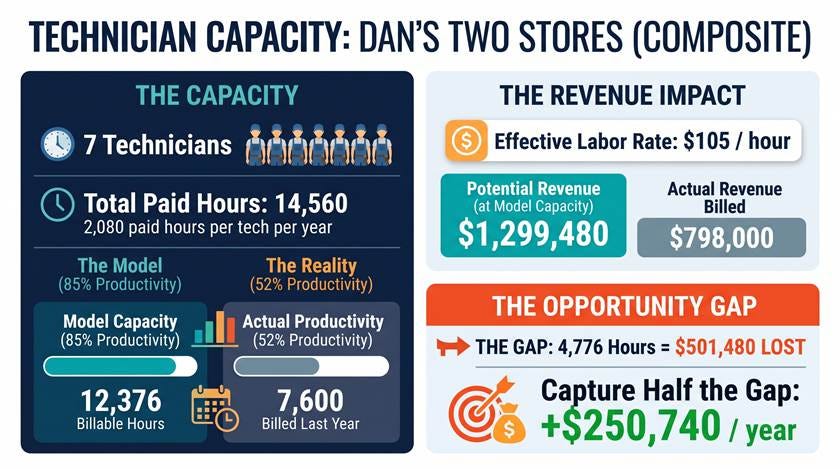
Dan’s techs bill 52% of the hours he pays for. The gap to an 85% model is 4,776 hours. At his $105 effective labor rate, that’s $501,480 a year.
Get half of it back, and service brings in another $250,740. Same 7 people. Same two buildings.
And Dan has no idea his number is 52%. Ask him, and he’ll tell you his techs are busy, and he’s right. They are busy. Busy and billing are two different measurements, though. At one store, he can see the difference as he walks through the shop. At two, he can’t.
Break 4: Cash you can see
With one store, the bank balance tells you roughly how the month is going. I’ve known owners who could call their month within a few thousand dollars just by checking the account on the 20th.
With two stores, one store’s good month covers up the other store’s bad one. That thin Wednesday deal, the rental cars earning nothing while they sit, the parks contract that’s about to walk. None of it shows up in the bank balance until a quarter later, if it shows up at all.
Greiner’s fix for the leadership crisis is structure. Managers, written procedures, measurement, budgets. In a golf car dealership, that means a manager in each store who isn’t the owner. A dealer management system that actually tracks schedules and parts lists. And financial statements by store and by department that a banker would want to read. Most dealerships need all of that at about 25 employees. Dan has 31.
“You built store one by being everywhere. You have to build store two by being measurable. It’s a different job, and nobody hands you the job description.”
One more reason this can’t wait. Your customer has moved.
I talk a lot about the five phases a customer goes through. First, they want the innovative product. Then they want a better price. Then total cost of ownership. Then they want to tie up less capital, so they rent, lease, or pay by usage. Then they want a custom solution.
Dan’s grandfather sold to phase 1 and 2 buyers. Dan’s parks department buys in phases 3 and 4. They want uptime, maintenance records, cost per hour, and a loaner when a unit’s down. In our census, 98.5% of golf car dealer owners run organizations built for phases 1 and 2. Commercial buyers are already further down the road than most of the dealers selling to them.
The Pivot: Keep What Built Store One
So what do you keep, and what do you let go of?
I’ve spent a lot of time this year looking at dealer Facebook pages, and owners like Dan are easy to spot. They build things and want you to see them. Family and years in business are all over the page. The customer is in every good photo. They’re rooted in one town. They’re hands-on, and they never have enough time. They’re always hiring a tech. And they’ll believe a number from another dealer before they’ll believe anything on a manufacturer’s program sheet.
I say that with affection. I’m the same way.
Those first four habits are why customers buy from Dan. Keep them. They should make it through store two and store three just fine.
Doing it all yourself is the one that has to go. And trusting other dealers is how you get it done.
Here are five moves I suggest to every owner in Dan’s spot.
1. Pick five numbers and look at them every Monday, store by store.
Tech productivity, service absorption, parts fill rate, days in stock on used carts, and rental fleet utilization. Those five numbers do the shop walk-through for you. If your DMS can’t spit them out, have each store manager fill in a spreadsheet on Friday afternoon. This will cost you nothing.
2. Put a named manager in each store and give that person a dollar limit.
The beach store needs somebody who can approve a deal down to a set margin, reorder a part, and call the parks department back without phoning Dan first. Most of the time, that’s a promotion for somebody already on the payroll. Honestly, the dollar limit matters more than the title.
3. Get the schedule and the parts list out of your head.
Put every service appointment, every rental maintenance interval, and every commercial contract due date into the system you’re already paying for. Then set min and max stocking levels on the 50 parts that keep your rental and commercial units running. That 11-day part turns into a 1-day part. The parks contract turns into a reminder 10 days before it’s due.
4. Let each store post its own deliveries.
Keep doing the delivery photos. They work. In a six-month study of four RV and trailer dealers’ Facebook pages, dealership photos got 8.87% click-through, and stock images got 0.98%. Let the beach store’s salesperson take the picture and post it, though. Every time one shows up, Dan gets a little signal that store two has its own people running it. Also free.
5. Put your numbers next to somebody else’s.
Dan’s 52% means little to him until he sees a three-store dealer in another state running 78% and hears how they got there. Owners like Dan will change how they run their place for a number they trust. And the number they trust most comes from another owner.
Four of those five don’t need new software, new people, or a new marketing budget. Number 2 usually means a raise for somebody who’s earned it anyway. You can’t do number 5 alone, because nobody publishes the operating numbers of private golf car dealerships. Believe me, I’ve looked.
So here’s how it goes for Dan if he makes those five moves before he signs that third lease. The beach store has a manager by July. Tech productivity is on a Monday sheet by August. Half the capacity gap returns over the next 12 months, $250,740 in labor revenue. And store three opens with a manager already named, a parts list already loaded, and an owner who finds out about a resignation the day it happens.
“The best thing you can hand a growing dealer is another dealer’s numbers.”
The Call to Action: Come Sit at the Table
Where does an owner find numbers they can trust?
In a room full of other owners. That’s been my answer for a long time.
I started a Best Practice Dealer group back in 2004. Six of the original ten members are still in it, which says something good about the format, or something about how stubborn golf car dealers are. Probably both. I’ve run these groups for more than 30 years, across golf car and LSV, agricultural, construction, material handling, and powersports dealers. The format hasn’t changed much, because it works.
Here’s how it runs. Each group is 10 to 12 dealers, no two in the same market, and we keep it small on purpose. We meet in person twice a year for two days. Each meeting starts with a State of the Dealership from each member: volume, productivity, retention, and whatever keeps them up at night. With 10 members, I put everyone on a 15-minute timer, or we’d never make it to lunch.
Then we walk through the financial composite. Every column is one member’s dealership. The columns on the right show the group average and the Wise Wolf Model Benchmark. Everyone gets a gap analysis, and everyone leaves with a written commitment the group will ask about next time. Then we do the Idea Exchange. Each member brings one idea they’ve actually put to work, and the group votes on the best one. People get competitive about that vote.
Between meetings, there are composite calls and a one-on-one call with each member every quarter. And yes, I’ll pester you for your numbers. Every group I’ve ever run has a couple of people I have to chase. It comes with the job.
The peer pressure does the work. The composite is the proof.
Here’s the math for Dan.
RETURN ON GROUP DUES: DAN’S SERVICE GAP ALONE
Half of the technician capacity gap ..........………………………………...... $250,740 a year
Best practice group dues ($335 x 12) ...………………………………….............. $4,020 a year
-------------------------------------------————————---------------------------
Return on dues ...........................……………………………………………………................. 62 to 1
Travel, lodging, and shared meeting costs are billed separately and are not counted above.
And that’s just service. It doesn’t count parts fill, used carts sitting too long, or rental cars earning nothing while they wait on a part.
So if you’re running two or three stores, or you’ve got the lease for number two sitting on your kitchen table, there’s a seat for you in a group with nobody from your market in it.
Monday morning, do two things. Write down your five numbers by store, even if half the boxes are blank. Most people’s are, the first time. Then send me an email. We’ll look at your numbers together, and I’ll tell you which group fits.
SOUND LIKE YOUR SATURDAY?
Wise Wolf Consulting runs Best Practice Groups for golf car and LSV dealers in non-competing markets. Two in-person meetings a year, a financial composite and gap analysis every time, and a written commitment you carry to the next meeting.
Email me at george@wisewolfconsulting.com or call 508-579-4131. Bring your five numbers, blank boxes and all, and we’ll figure out which group fits your market.